
This week, Chroma Art Film Festival proudly features Dragon, the mesmerizing dance-theatre film from Daniel Belton & Good Company Arts. Blending myth, movement, and music, Dragon channels the celestial power of the legendary creature, exploring transformation through dynamic performances, soul-jazz soundscapes, and immersive digital art. A striking fusion of tradition and innovation, this cinematic journey invites audiences to step into higher dimensions of creativity and storytelling.
Overview
Good Company Arts presents Dragon, a breathtaking new dance-theatre film celebrating the Lunar New Year 2024. Directed by Daniel Belton, this experimental short film unites artists from Japan, Australia, and Aotearoa in a mesmerizing fusion of dance, music, and digital arts.
With a soul-jazz-infused score by Mark de Clive-Lowe, interwoven with taonga pūoro from Mahina-Ina Kingi-Kaui and Alistair Fraser, Dragon explores the celestial symbolism of the mythical dragon—a creature of courage, wisdom, and boundless power. Featuring IDIOT SAVANT Theater Company (Tōkyō) and virtuosic performers Nao Akao, Chikako Arai, and Yasuhiro Kondo, the film transforms the screen into a dynamic, shape-shifting realm of ancient myth and modern storytelling.
Blending poetic narration by Katherine Lyall-Watson (Belloo Creative, Australia) with stunning digital landscapes, Dragon reimagines the multiverse through movement and sound, expanding spatial geometries in an immersive cinematic experience.
Credits
- Director: Daniel Belton (Good Company Arts)
- Producer: Donnine Harrison (Good Company Arts)
- Key Cast:
- Chikako Arai – “Air”
- Nao Akao – “Water”
- Yasuhiro Kondo – “Earth”
- Music: Mark de Clive-Lowe
- Taonga Pūoro Artists: Mahina-Ina Kingi-Kaui, Alistair Fraser
- Script: Katherine Lyall-Watson (Belloo Creative, Australia)
- Performers: IDIOT SAVANT Theater Company (Tōkyō), Airu Matsuda, Samara Reweti
Specifications
- Project Type: Experimental, Music Video, Short
- Runtime: 13 minutes
- Completion Date: February 9, 2024
- Production Budget: 85,000 NZD
- Country of Origin: New Zealand
- Filming Locations: Japan, New Zealand
- Shooting Format: 4K Digital
- Aspect Ratio: HD
- Film Color: Black & White and Color
- First-time Filmmaker: No
- Student Project: No
Director Biography: Daniel belton (Good Company Arts)

Daniel Belton is an internationally recognized New Zealand artist, director, choreographer, and filmmaker. As the founder and artistic director of Good Company Arts, Daniel has been at the forefront of contemporary dance, digital cinema, and multidisciplinary art for over two decades. His visionary approach fuses choreography, fine arts, music, animation, and AV technology, creating immersive works that transcend traditional artistic boundaries.
A Te Tumu Toi New Zealand Arts Foundation Laureate, Daniel’s work is celebrated for its innovative spatial design, often exploring themes of geometry, mythology, and human movement in digital landscapes. His films and installations have been presented in theatres, art galleries, museums, cinemas, architectural facades, planetariums, and virtual reality environments worldwide.
With a commitment to cross-cultural collaboration, Daniel has worked with prominent artists, musicians, and digital designers from around the world, creating projects that merge South Pacific heritage with cutting-edge technology. Through Good Company Arts, he continues to push the boundaries of dance-theatre and experimental film, crafting works that resonate with deep symbolism, intricate movement, and stunning visual storytelling. His latest project, Dragon, exemplifies his ability to blend celestial mythology, geometric play, and human emotion into a dynamic cinematic experience.
Director Statement
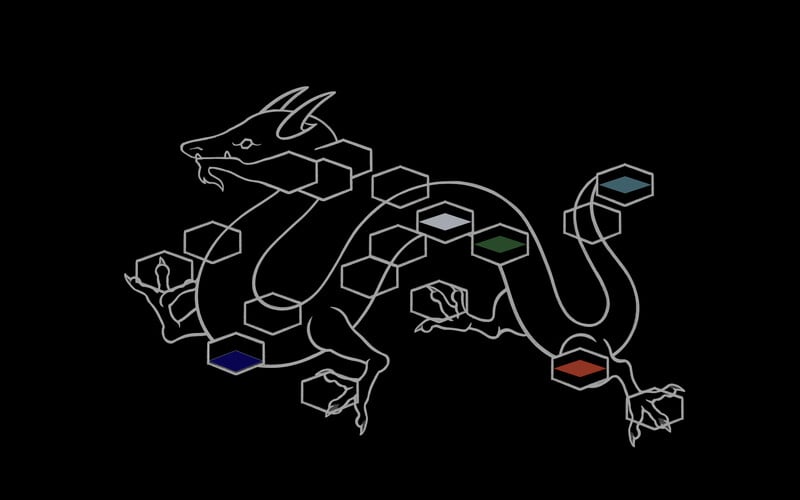
“For the Dragon film, Chika Arai’s dance is the ecstatic ‘dance like nobody’s watching’ release. The geometry of the hexagon in filmic spatial play references origami—within the concertina of the fold exists the potential for the surprise of new dimensions, expanding spatial perception as discovery. The game-board matrix of this work, with its building block elemental design pieces and honeycomb cell layouts, offers multi-level interaction for the participants—the performers’ presence and the music drive the narrative of Dragon. The arrival of the dragon signals colour codes, and geometric designs accompany these codes as each of the screen performers represents an element.
Our film is celebrating the ‘Year of the Dragon’, teasing the folding and unfolding of space and the re-registration of environment. It is the human questing, supported by the energies of the dragon, which represents the ‘passing of the baton’ of responsibility—from the celestial wisdom of the dragon to the human, to say: You are worthy. Are we worthy? Can we do this? This is the challenge—are we ready for greater responsibility? The hexagon is the sacred geometric baton, referencing Metatron’s Cube in our play from pixel spaces and the binary of ones and zeros. This extends out through the power of gesture, movement, and music—to the abandon capable of dance. There is this sense of the dragon investing in the human with optimism. The message embedded within the Dragon film offers a kind of geometry of trust, a spatial language crystalline in climax moments, even prismatic with spectral hues occurring where film frames intersect. For our opening scene, Lyall-Watson’s script affirms: ‘Net of hope holding safe.’
Dragon resonates with the poetics of human movement through spectacular dance-gesture performances, immersive 3D motion graphics scenography, and a magnificent music score. Dance-theatre, sound, and optics intertwine to re-sculpt the digital stage through a series of five scenes. The hexagon frame which contains our story is a galactic ship, pulsing temporally, gliding and refracting light as multi-prism portals tracking the key elements: AIR (Silver-White performed by Chikako Arai), WATER (Blue-Green performed by Nao Akao), EARTH (Green-Grey performed by Yasuhiro Kondo), FIRE (Red-Orange performed by Airu Matsuda), and VOID (Violet performed by Samara Reweti). This project creates a syncopated dialogue, leveraging the pattern of the hexagon—its six-sided scales and stepped cubes manifest scenographies that respond to and provoke the presence of the screen performer.
A line that works diagonally in space creates the illusion of three dimensions because it suggests depth. We are used to the idea that low on the picture plane is near, and high is far—a Western thought paradigm. The design in Dragon references orthogonal perspective. Axonometry is a type of orthogonal projection, yet, having all the lines of an object at the same length, they are not drawn as shortening into the distance, which renders an unnatural compression. Architects use this descriptive drawing methodology to generate planar images of three-dimensional objects and structures. Jac Grenfell’s exquisite motion graphics, authored from hand-animated ink on glass, suggest hills or valleys, with ridges and mountain peaks that roll out as rhythmic vistas for the performers to inhabit. He describes the film’s opening sequence as: “The ratio of the theatre space, pushed out to the edge of frame, opening up an alternative esoteric world.”
The celestial dragon is celebrated as a totemic being within our electronic game-like film journey, where time can rewind, cut, warp, and weft. The digital amalgam of light and sound that we know and love as cinema hosts this party to honour the divine dragon.”
📲 Follow the filmmaker:@goodcompanyarts


