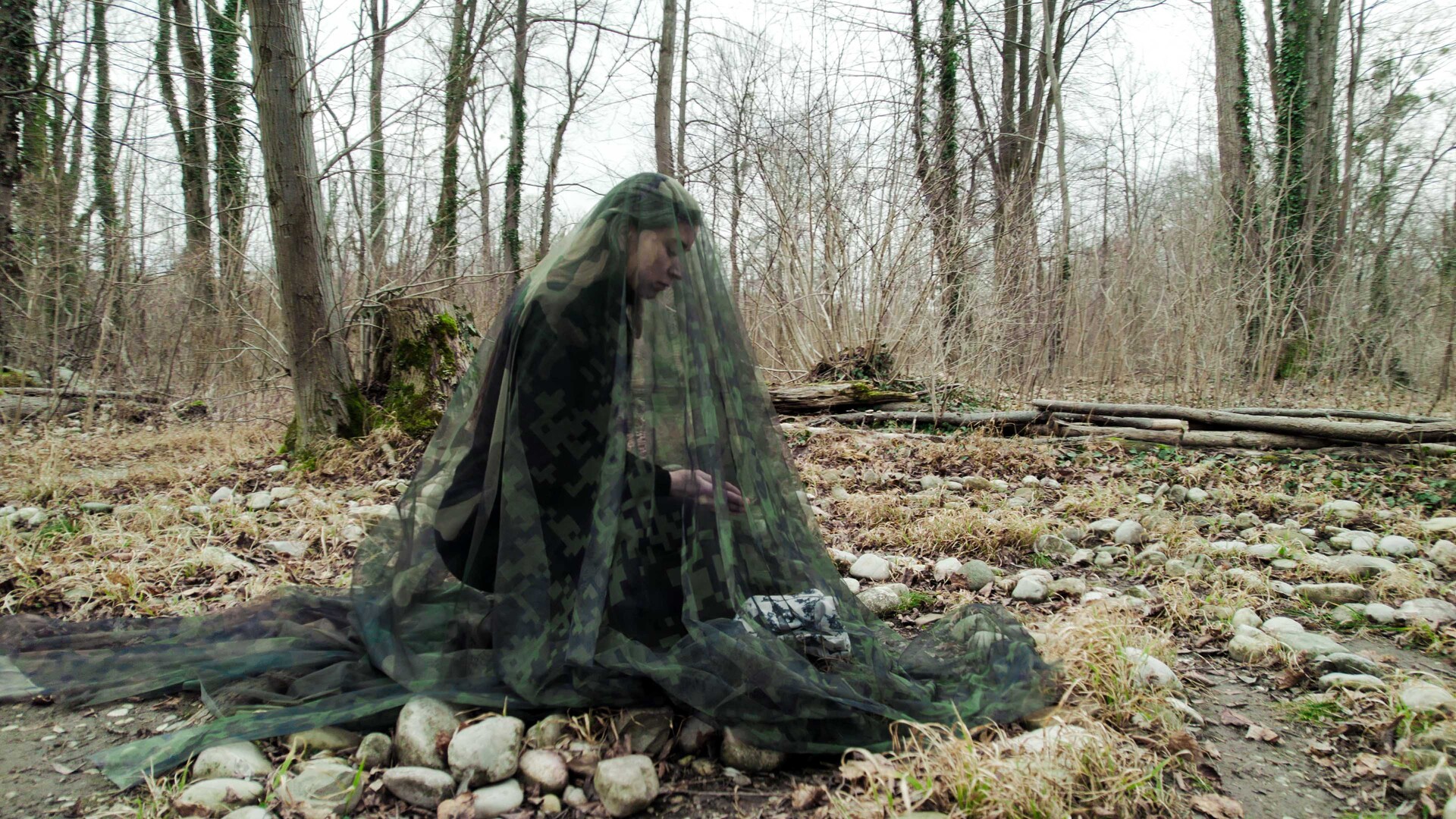
This week, Chroma Art Film Festival proudly features Traces of Life / How to Kill, Veronika Dräxler’s haunting and visually immersive performance trilogy. The film takes audiences across forests, war memorials, and urban battlefields, tracing the physical and emotional scars of conflict through the eyes of three women.
With a bold interdisciplinary approach, Traces of Life / How to Kill blends performance art, cinematography, and war research, challenging how we document trauma, resilience, and survival. In a world constantly shaped by violence, the film reminds us that our bodies, landscapes, and memories remain interconnected — haunted archives of history.
Overview
In this visually arresting trilogy, three female figures navigate the aftermath of war and loss, embodying the tensions between survival and grief. Part 1 (Hunt) follows a wisewoman hunting in the frozen forests of Finland, while Part 2 (Care) A war widow mourning the UN Genocide Convention under a camouflage veil with patterns tied to war crimes in a spiralling stone garden in Germany. The final chapter, Ruin, transforms La Défense in Paris into a deserted, war-torn urban battlefield, where a warrior wrestles with memory and destruction.
Traces of Life / How to Kill pushes the boundaries of documentary storytelling, weaving personal experience, historical trauma, and site-specific performance into a raw, poetic reflection on what it means to live with — and through — violence.
The project was informed by firsthand experiences in Ukraine during an EU-funded residency, as well as global echoes of conflict seen in Gaza, Western Europe, and beyond. Combining performance, film, poetry, and archival imagery, Veronika Dräxler creates a powerful artistic act of remembrance.
Credits
Director: Veronika Dräxler
Producer:
- Veronika Dräxler
- Patrick Alan Banfield (Neuzeit Filmagentur)
Key Cast:
Matti Keränen – Hunter
Veronika Dräxler – Wisewoman, Widow, Warrior
Cinematographers:
- Juha Niemela
- Max Knoop
- Ekaterina Vorontsova
Sound Composer: Sascha Blank
Editor: Amélie Richter
Colorist: An Laphan
Production Assistants: Becky Hastings, Anna Rytsareva
Costume Designer (Part 3): Tyler Wishneff
Graphic Designer: Alina Holtmann
Funding:
- Steiner Stiftung
- Bayerisches Staatsministerium für Wissenschaft und Kunst
Specifications
- Project Type: Experimental Short
- Runtime: 15 minutes 45 seconds
- Completion Date: January 31, 2025
- Production Budget: $15,000 USD
- Country of Origin: Germany
- Countries of Filming: Finland, Germany, Ukraine, United Kingdom
- Language: English, German
- Shooting Format: Digital
- Aspect Ratio: 16:9
- Film Color: Color
- First-time Filmmaker: Yes
- Student Project: No
Director Biography: Veronika Dräxler

Veronika Dräxler is a German-Ecuadorian media and performance artist exploring the intersections of trauma, memory, and survival through interdisciplinary storytelling. Educated at the Academy of Fine Arts Munich and the Berlin University of the Arts, she studied under Klaus vom Bruch and Andrea Fraser, honing her experimental and research-driven approach.
Her work has been supported by leading institutions, including the Bavarian Ministry of Science and Art, German Federal Government, and Stiftung Niedersachsen. Internationally, her films and performances have appeared at venues such as Museo Pumapungo (Ecuador), a.topos (Venice), and Manifesta 11 (Zurich).
For Traces of Life / How to Kill, Dräxler traveled across Finland, Germany, Ukraine, and France, embedding her own body into landscapes of violence. Through ritual-like performances, she transforms physical sites into living testimonies — asking how we hold history within ourselves.
Director Statement
“Traces of Life / How to Kill started in 2022 as a project about people with licenses to kill — hunters, soldiers, even machines. But the work evolved with the world around me. It became a personal and political meditation on how trauma shapes bodies, landscapes, and memories across time and space.
In 2024, during my residency in Lviv and Kyiv, I lived under the constant threat of war — from conversations with locals to spending nights in bomb shelters during drone strikes. That experience changed everything. I carried those moments into the trilogy, weaving them with memories from the Gaza crisis, the Venice Biennale’s Beati Pacifici exhibition, and war poetry by Giorgio Caproni, Margaret Atwood, and Karl Shapiro.
This project is a physical act of remembrance — a gesture that honors those who live with violence while asking what it truly means to survive.”
Follow the filmmaker:


